
800W vs. 600W Micro-inverters: Why the UK Limit Matters
The current retail market is saturated with conflicting specifications. Buyers frequently encounter European kits throttled to 600W competing alongside newly specified UK kits rated at 800W. To compound the confusion, manufacturers routinely bundle both options with 1000W or more of solar panels. This discrepancy between inverter AC output vs DC panel wattage leaves consumers unsure of what is legally permitted on a standard domestic circuit.
When evaluating an 800W vs 600W micro inverter UK setup, understanding the regulatory baseline is mandatory to avoid voiding tenancy agreements or compromising electrical safety.
The regulatory landscape has now formalized to remove previous ambiguities. Coordinated efforts between the UK government, the Energy Networks Association (ENA), Ofgem, and regional Distribution Network Operators (DNOs) have established the definitive UK plug-in solar limit 2026. This legal framework relies on critical updates to the distribution code and the implementation of BS 7671 Amendment 4 800W parameters.
Under these updated rules, UK households are officially permitted to connect plug-in solar systems directly to domestic mains sockets without commissioning an electrician. The defining legal metric is that the alternating current (AC) output must be strictly capped at 800W, a standard met by hardware such as the EcoFlow PowerStream 800W.
While installation is ‘plug-and-play’, operating at this threshold still legally requires a G98 notification 800W submission to your regional network operator. Attempting to bypass this limitation and plug in an inverter capable of exceeding 800W AC output constitutes an unauthorized grid modification and introduces immediate thermal risks to standard household wiring.
AC Output vs. DC Panel Wattage: The 800W Audit
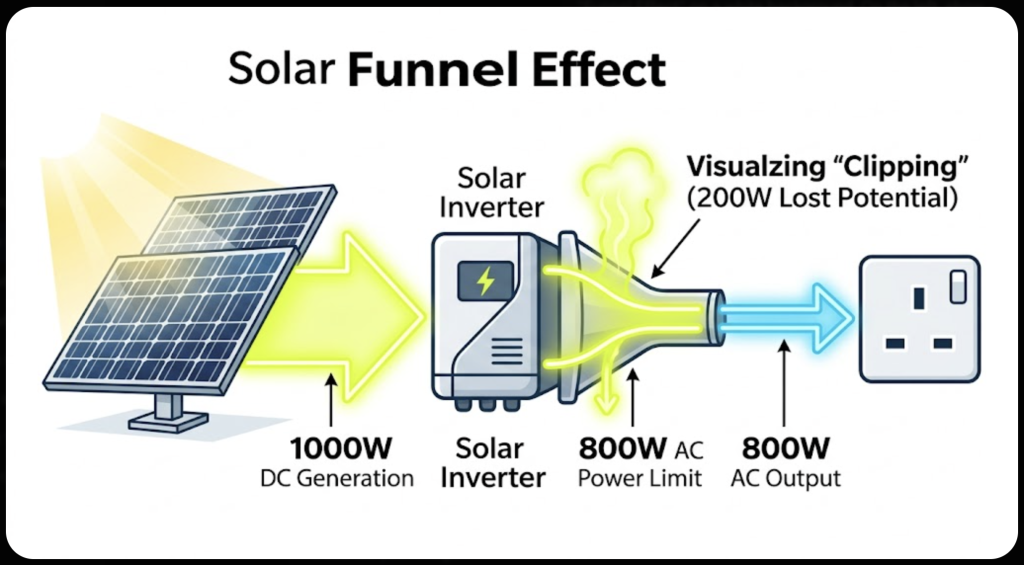
The core misunderstanding in plug-in solar is the distinction between DC Generation (Panels) and AC Output (Inverter). If you do not understand the relationship between these two metrics, you will either under-equip your balcony or buy hardware that violates the UK’s 800W legal ceiling.
This 15-parameter diagnostic evaluates your hardware’s “Oversizing” logic and calculates your specific “Clipping” threshold for a 2026-compliant installation.
600W vs 800W: The Historical & Practical Difference
Understanding why 600W units still permeate the market and why strictly securing an 800W micro-inverter is the mathematically superior choice for UK installations.
The 600W European Legacy
Before the UK formalized the 800W limit, the European market—heavily driven by Germany—operated on a strict 600W limit for balcony power plants. Manufacturers optimized their production lines for this threshold, which is why older stock, grey-market imports, and DIY components frequently feature 600W inverters.
However, the regulatory landscape has evolved. In 2024, Germany’s Solar Package 1 officially increased this feed-in limit from 600W to 800W to empower urban solar and maximize distributed generation. The UK’s BS 7671 Amendment 4 aligns with this modernized 800W standard. Purchasing a legacy 600W unit today deliberately leaves 200W of legal, usable capacity unutilized.
The Math of 800W & Grid Safety
The G98 engineering recommendation dictates the rules for connecting micro-generators to the UK grid, allowing a maximum of 16 Amps per phase without requiring prior DNO permission. Given that the UK’s nominal low voltage network operates at 230V, a 16A limit permits up to 3.68kW of generation.
An 800W micro-inverter draws approximately 3.47 Amps (800W ÷ 230V). This sits exceptionally comfortably within the 16A threshold of G98. The mathematics prove that an 800W plug-in system poses absolutely zero threat of overloading standard domestic 32A ring mains or tripping standard circuit breakers, validating its classification as a user-installable appliance.
Why 800W Wins in the Overcast UK
The additional 200 watts of AC capacity provided by an 800W inverter is crucial in the UK’s frequently overcast climate. An 800W limit allows you to safely connect larger, oversized DC solar arrays (e.g., 1000W to 1200W). By upgrading to an 800W unit, your system can capture and convert more solar energy throughout the day, significantly boosting power production during peak sunlight hours.
This DC oversizing ensures that even when thick UK cloud cover reduces panel efficiency to 50%, a 1200W DC array will still generate 600W. If you were restricted to a 600W inverter (with correspondingly smaller panels), that same cloud cover would drop your output to an unusable 300W. The 800W ceiling ensures a broader, flatter generation curve that offsets your baseload more consistently across varying weather conditions.
Domestic Circuit Safety: Why Not 1000W?
Addressing the “more is better” fallacy. The 800W ceiling is a hard mathematical constraint designed to prevent the physical degradation of your property’s electrical infrastructure.
The Fatal Flaw of “More is Better”
The consumer instinct to maximize wattage is fundamentally flawed when applied to decentralized plug-in generation. The 800W limit defined under BS 7671 Amendment 4 is not an arbitrary bureaucratic suggestion; it is a rigid physical constraint engineered to prevent catastrophic thermal failure within your property’s electrical infrastructure.
Pursuing a 1000W or 1500W plug-in inverter because it appears to offer a superior generation yield demonstrates a critical misunderstanding of how the UK electrical grid interacts with localized, unregulated current injection. This module forces a clinical review of the physics underlying the regulations.
1. The Mechanics of the UK Ring Main
UK domestic properties utilize a ring main architecture, typically wired with 2.5mm² twin and earth copper cable, protected at the consumer unit by a 32-Amp Miniature Circuit Breaker (MCB). The MCB is a failsafe designed to sever power if your appliances attempt to draw more than 32 Amps from the grid, preventing the cables inside your walls from melting.
However, when you plug a micro-generator into a wall socket, you inject unregulated electrical current behind the protective breaker. If you inject 2000W (approx. 8.7 Amps) of solar power into the circuit, the cables could theoretically carry over 40 Amps (32A from the grid + 8.7A from the solar) before the MCB detects an overload from the grid side. Over time, this undetected current load degrades the PVC insulation on the cables, directly elevating the risk of electrical fires. The 800W (3.47A) limit provides the maximum mathematically safe buffer for older, potentially degraded household wiring without exceeding thermal tolerances.
Illustrative Visual 1: Thermal Overload Mechanics
Chart demonstrates maximum theoretical current load on a standard 32A ring main during unregulated solar injection.
2. The Threshold of Hardwiring
The moment your micro-inverter’s AC output exceeds 800W, your hardware permanently loses its classification as a user-installable “simplified appliance.” It is legally reclassified as a permanent structural grid modification. At this threshold, you can no longer legally utilize a standard 13A wall plug for the connection.
This reclassification immediately requires the commissioning of a certified electrician, structural alterations to the rental property to route new cabling, and formal, written landlord permission. The project transitions instantly from a portable, renter-owned plug-and-play appliance into a permanent, structurally integrated fixture that you cannot easily take with you when the tenancy concludes.
Illustrative Visual 2: The Compliance Divergence
Hardware Ecosystems: EcoFlow vs. Anker
Translating technical compliance theory into real-world hardware. Both Tier-1 manufacturers have engineered sophisticated solutions designed to exploit the UK’s 800W legal threshold, but their architectural approaches differ significantly.
EcoFlow
PowerStream
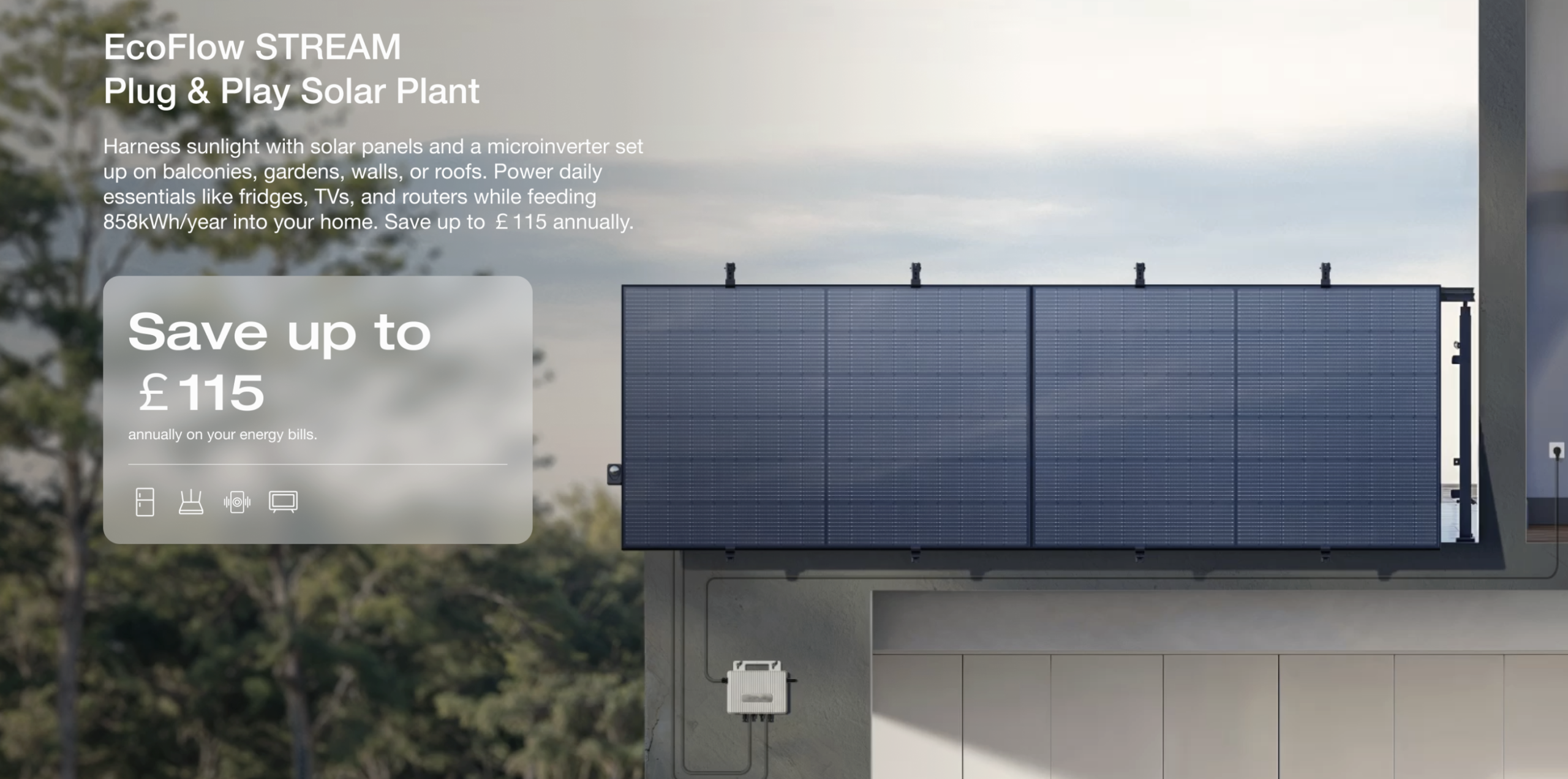
EcoFlow’s architecture is built around the PowerStream micro-inverter, which strictly adheres to the 800W AC output limit required for UK BS 7671 Amendment 4 compliance. This ensures total grid safety while maximizing permitted yield.
In direct response to the formalized 2026 regulations, EcoFlow has also introduced the STREAM kit. This is a highly streamlined, simplified, and aggressively priced 800W plug-and-play package. It is designed specifically for the UK renter market, removing the complexity of multi-component builds to provide an instant, legally compliant peak-shaving solution straight out of the box.
Anker
SOLIX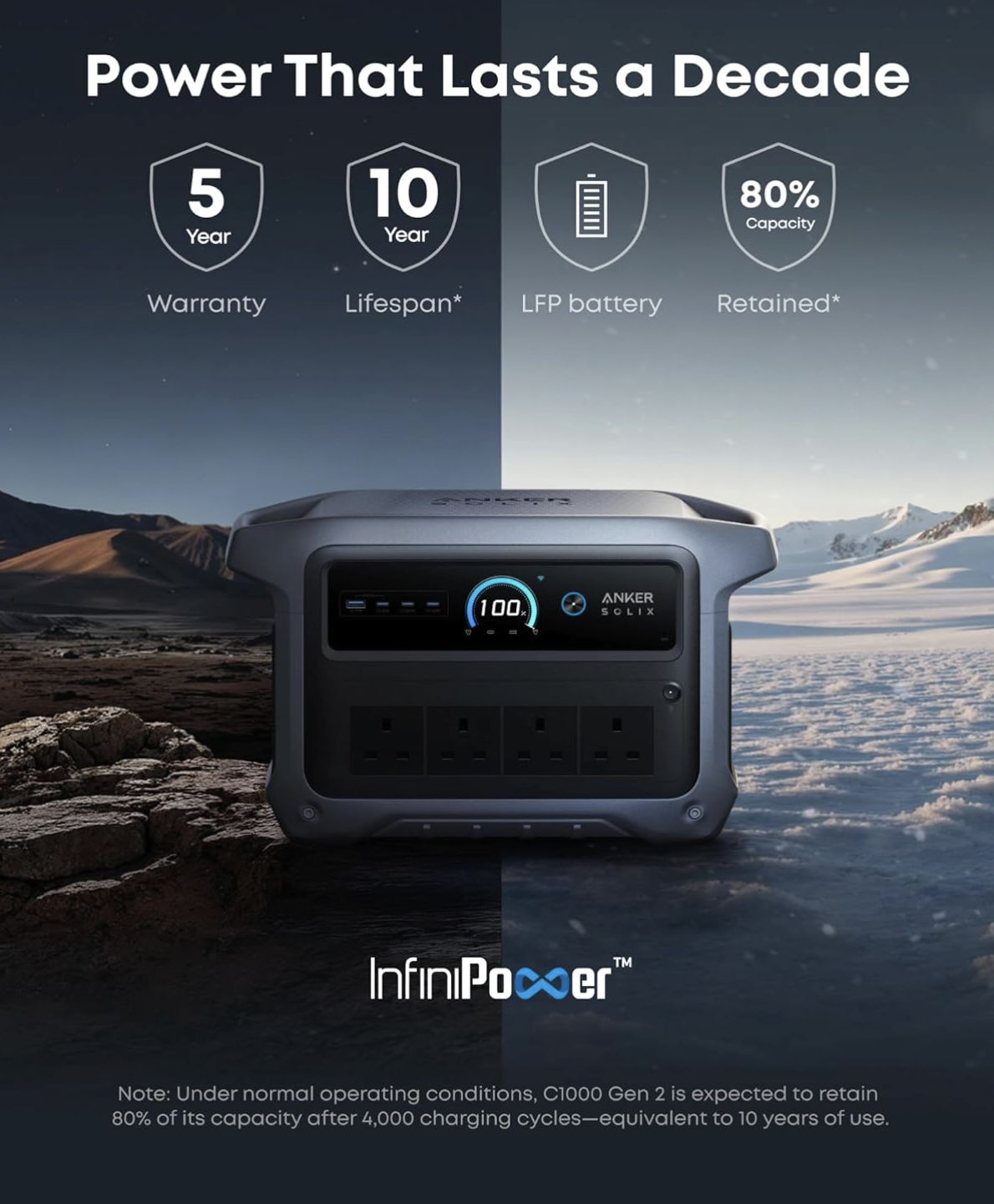

Anker’s engineering logic heavily prioritizes the “DC Oversizing” strategy. The SOLIX Solarbank 2 architecture is designed to support up to 1200W of raw DC solar input, distributed across two independent MPPT (Maximum Power Point Tracking) ports. This dual-port design is perfect for split East/West orientations.
While it accepts massive DC input to thrive in cloudy UK conditions, the SOLIX’s bi-directional AC inverter remains rigorously locked. It legally caps the grid feed at exactly 800W. This means you can install aggressive amounts of solar panel capacity to guarantee performance on overcast days, confident that the hardware will automatically throttle (clip) the output to maintain total G98 and tenancy compliance on sunny days.
The Battery Factor: Defeating Clipping Losses
In the previous section, we established that “clipping” (losing DC yield that exceeds the 800W AC limit) is a necessary function of compliance. However, introducing a battery module into either of these ecosystems radically changes the physical dynamics.
Related Articles
-
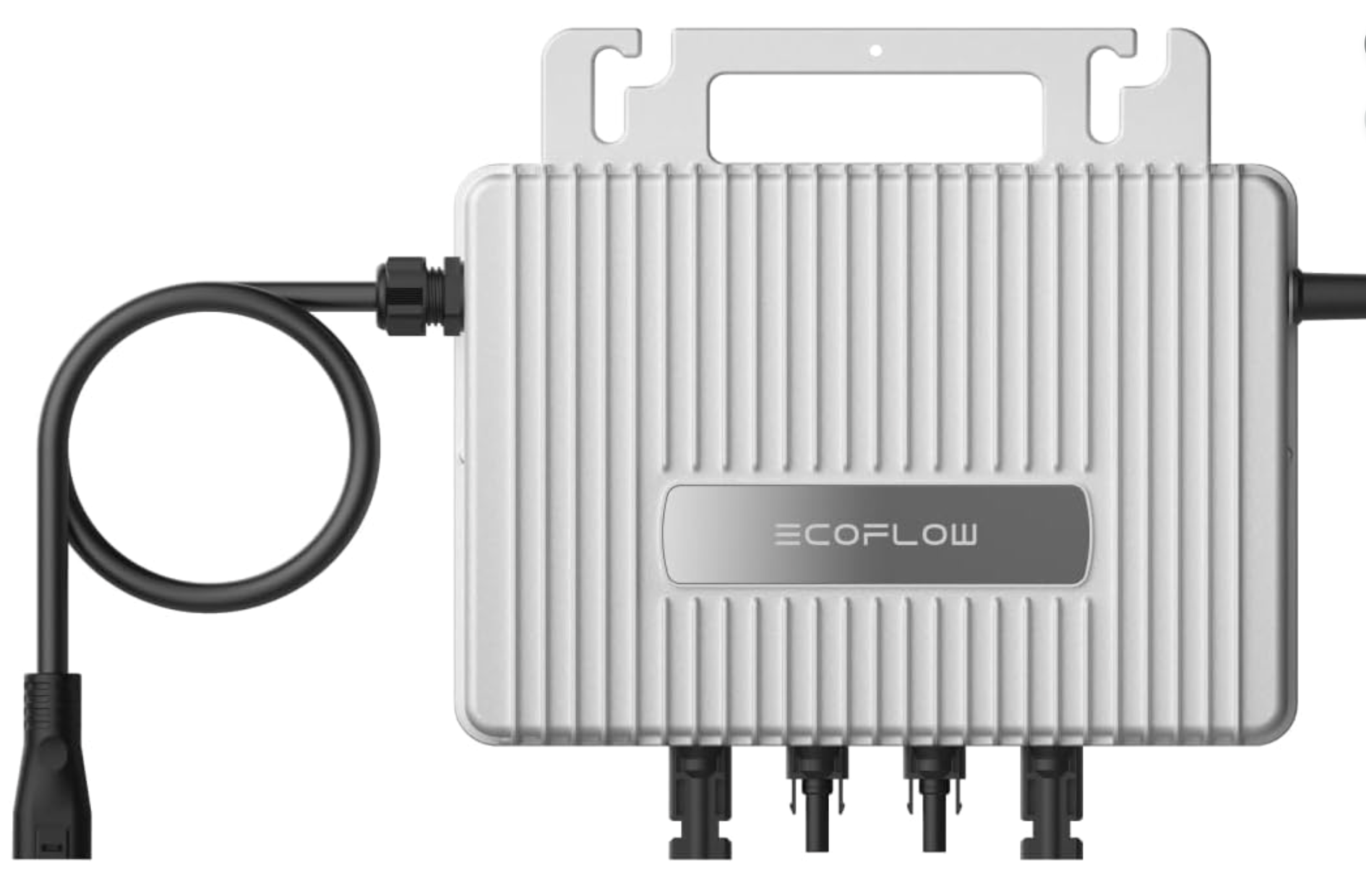
EcoFlow STREAM Microinverter Technical Audit
EcoFlow STREAM Microinverter Technical Audit EcoFlow STREAM Microinverter Technical Audit The mandatory brain of the UK balcony operation. A clinical evaluation of the 800W hard-cap, the 0.1-second anti-islanding relay, and why bypassing G98 grid compliance is a mathematical and legal liability. Technical Hardware Audit // RentalRenewables.co.uk BS 7671 & G98 Compliant EcoFlow STREAM 800W Microinverter…