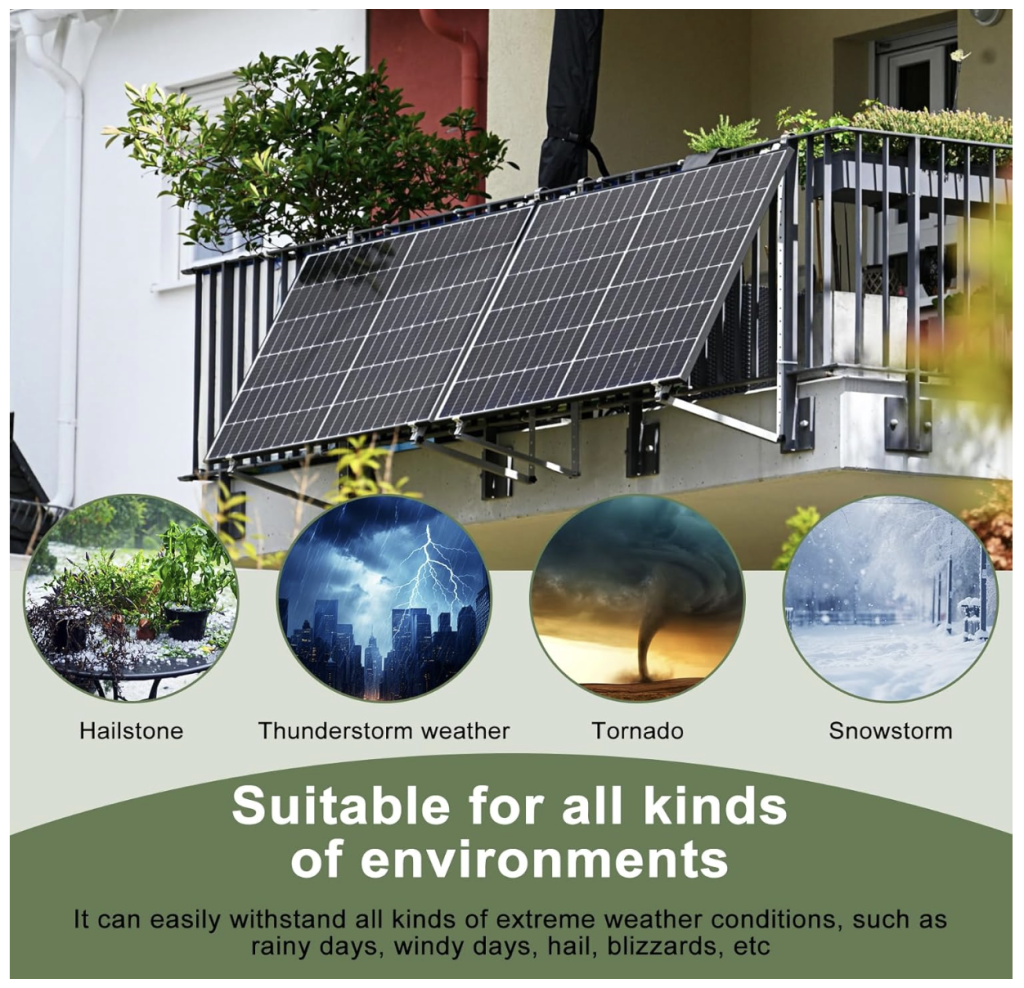
For years, plug-in solar in the UK operated in a frustrating legally grey area. While our European neighbours adopted “plug-and-play” standards years ago, UK renters were left navigating a minefield of vague tenancy clauses and overly cautious electrical guidelines that treated a simple balcony panel like a full-scale industrial installation.
The landscape changed in April 2026. The formal acknowledgement of BS 7671 Amendment 4 finally established clear safety parameters for sub-800W systems. This wasn’t a “deregulation” but rather a technical recognition that micro-generation, when handled correctly, is a safe domestic appliance rather than a structural risk.
This guide provides a clinical breakdown of the current environment.
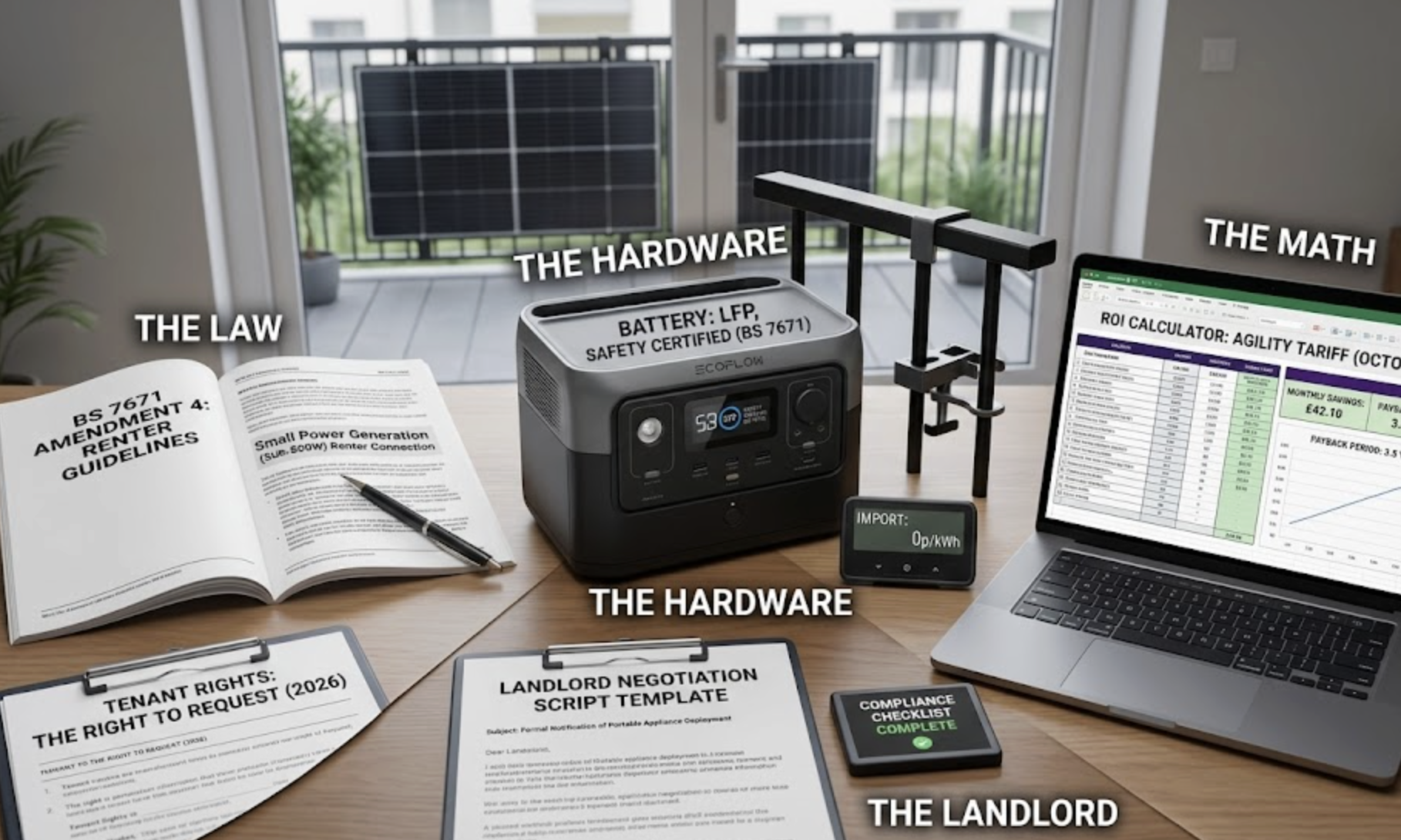

The Law
Navigating the specific requirements of Amendment 4 and your rights as a tenant.
The Math
Calculating actual ROI on UK smart tariffs without the marketing fluff.
The Hardware
Evaluating ecosystems like EcoFlow and Anker against UK safety standards.
The Landlord
Technical scripts to manage the landlord relationship using compliance as your primary lever.
The 2026 Regulatory Shift: Is Balcony Solar Finally Legal?
The short answer is yes, but the technical reality is more nuanced than most marketing materials suggest. The “ban” on balcony solar was never a statutory law, but rather a lack of technical standards that left insurers and landlords with zero appetite for risk.
Under the BS 7671 Amendment 4 update, the UK now recognizes systems that meet the following criteria as compliant domestic appliances:
The AC output of your micro-inverter must be software-locked or hardware-limited to 800W. This ensures that back-feeding electricity into a standard UK ring main does not exceed the thermal capacity of existing 2.5mm² wiring.
The system must feature a certified “shut-off” that kills power to the plug pins within 0.1 seconds of being disconnected. This is the difference between a safe appliance and a lethal hazard.
Legality is contingent on notification. Even a plug-in system must be registered via the G98 “Connect and Notify” process within 28 days of installation.
If your setup ignores these parameters, it remains an unauthorized modification. If it adheres to them, it is a legally protected household asset.
Compliance Setup Checker
Quickly check if your planned balcony solar setup adheres to the 2026 standards.
Note: This tool provides general guidance based on criteria shared in Silo 1. Full legality depends on specific implementation details.
How much of a priority is DNO notification for you, or are you more concerned about the physical mounting restrictions of your specific tenancy?
The G98 Notification Process Explained
While the technical regulations surrounding balcony solar have modernized, the legal requirement for grid integration remains firm. For any system operating in parallel with the low-voltage grid—including plug-in kits—a G98 notification to your local Distribution Network Operator (DNO) is currently the only correct legal pathway.
G98 vs G99: Which Application Do You Need?
Approval permits systems to export electricity to the grid. Use the comparison below to identify the correct Distribution Network Operator (DNO) pathway for your setup.
- Install system
- Notify DNO within 28 days
- Receive approval
- Submit application to DNO
- Receive approval
- Install system
Interactive Guidance: Select your system type to highlight the required pathway.
Grid Compliance: Notification Requirements
The UK operates on a “Connect and Notify” principle. You have the legal right to commission a compliant sub-800W system immediately, provided you formalize the connection with your Distribution Network Operator (DNO) following the steps below.
Compliance is tethered to a strict administrative window. You must submit your G98 Form B within 28 days of “commissioning” (the first moment the system exports to the grid).
- Commissioning Date: The day you plug in and activate the inverter.
- DNO Submission: Emailed or uploaded to your local network operator’s portal.
- Failure to Notify: Can lead to a “Notice of Disconnection” and may invalidate your home insurance policy in the event of a fire.
The DNO requires verification that your hardware won’t destabilize the local grid or harm engineers working on external lines.
PARAMETER: 0.1-second Loss of Mains (LOM) shut-off
CERTIFICATION: G98/1-4 Compliance Certificate
Ensure your EcoFlow or Anker micro-inverter is listed on the Energy Networks Association (ENA) database. You must attach the specific PDF certificate for your model to your notification.
Once submitted, the DNO will provide a confirmation letter or email. This is your primary shield against legal disputes.
- Tenancy Shield: Proof to your landlord that the installation is official and legally recognized.
- Insurer Verification: Essential for maintaining “Household Contents” coverage for your energy assets.
- MPAN Linkage: The generation is linked to your 13-digit Meter Point Administration Number (found on your bill).
How to Fill Out a G98 Form for Plug-in Solar
Submitting the G98 form is your final legal hurdle. This guide provides a clinical, step-by-step breakdown ensuring your plug-in solar achieves full regional DNO compliance.
G98 DNO Locator Tool
Before you can submit a G98 notification and secure the legal status of your balcony solar system, you must identify your Distribution Network Operator (DNO).
Future Outlook: A Simplified Pathway
The administrative burden of the current G98 process is a recognized hurdle for the widespread adoption of micro-generation. Consequently, the government is actively developing a simplified online registration pathway specifically for sub-800W systems. This future update aims to replace the more technical G98 form with a streamlined digital registration, treating plug-in solar with the same administrative ease as other smart home appliances.
Which stage of the notification process are you currently navigating—identifying your DNO based on your postcode, or are you ready to compile the technical certificates for your hardware?
The Unfiltered Math: Yields, Savings, and the SEG Trap
The SEG Trap: The Reality of Exporting
If you anticipate your energy supplier paying you for the electricity your balcony solar panels generate, you have misunderstood the regulatory framework. Traditional rooftop solar arrays rely on the Smart Export Guarantee (SEG) to generate financial returns. Under the SEG, suppliers are legally obligated to pay you for excess electricity sent back to the grid.
The critical caveat for renters: SEG payments require an MCS (Microgeneration Certification Scheme) certified installation.
Because balcony systems are “plug-and-play” appliances and bypass structural electrical work by an MCS-accredited engineer, they flatly do not qualify for the SEG. They also do not qualify for any standard government solar grants or zero-VAT incentives applicable to permanent fixtures.
Traditional Rooftop (MCS)
- Installation Cost £5,000 – £9,000
- MCS Certification Included
- SEG Eligibility Yes
- Avg. Export Rate (2026) ~15p / kWh
Balcony Solar (Non-MCS)
- Installation Cost £500 – £1,200
- MCS Certification None
- SEG Eligibility No
- Export Rate £0.00 / kWh
The conclusion is purely mathematical. Any surplus electricity your balcony system generates and feeds back into the grid is effectively “free energy” donated to your supplier. They will sell your generated power to your neighbor at full retail price, and you will receive nothing.
Your entire financial strategy must revolve around 100% self-consumption. If you are not consuming the energy you produce—either in real-time or by storing it in a local battery ecosystem—you are operating at a deliberate financial loss.
Grid Donation Calculator
Calculate the precise financial value of the uncaptured energy you are giving to your utility company for free due to lack of SEG eligibility.
The Realistic Financial Breakdown (2026 Metrics)
To understand the true ROI, we have to look at realistic yields based on UK weather patterns and standard electricity costs, deliberately ignoring manufacturer “best-case scenario” marketing.
If you manage to consume 100% of the energy generated (e.g., running your fridge, home office, or charging a battery during the day), the math is straightforward:
- Low End: 600 kWh * £0.27 = £162 annual savings
- High End: 800 kWh * £0.27 = £216 annual savings
If your system costs £600 to purchase, your payback period is roughly 3 to 4 years. This is an excellent return on investment for a consumer appliance, provided you understand it is a cost-reduction measure, not an income stream.
Adjust Your Parameters
Peak-Shaving: The True Financial Benefit
Because you cannot sell energy back without MCS certification, the mathematical goal of a renter’s solar setup is exclusively Peak-Shaving. This means using your yield to physically intercept and cancel the baseload draw of your flat, preventing the import of expensive daytime electricity.
The 9-to-5 Conundrum
A standard worker is absent during peak generation hours (10:00 – 15:00). Without a battery, the system covers the minimal baseload, but the vast majority of the 800W yield is hemorrhaged back to the grid for free. To maximize this strategy, battery storage is not a luxury; it is a technical prerequisite.